
Aggregator DPG Architecture
The Aggregator DPG is the aggregator-facing application of Blue Dots. It is a pnpm + Turbo monorepo, TypeScript-only, with three deployable apps.
The same portal signs up participants for any domain the deployment serves.
Three deployable apps
Section titled “Three deployable apps”api— Fastify backend-for-frontend. Owns the Aggregator database (Drizzle + Postgres), the Keycloak admin integration, and the registration/approval flow, bulk-upload entry point, registration links and profile endpoints. Reads the upstream Signals stack; in the MVP it has no write access to Signals except via the bulk-create paths. Every handler assertssession.aggregator_id— which is never trusted from the client.web— Next.js 15 (App Router) portal plus its own BFF. Anonymous flows use anaggregator-bffservice-account token (client-credentials); authenticated flows attach the user’s OIDC token. The session cookie carries only a session id — access tokens are never written to cookies, they live in Redis only. Forms are RJSF-driven from JSON schemas, so non-engineers can evolve registration/profile forms without code changes.worker— BullMQ jobs:bulk-file-process,bulk-row-process,bulk-finalise,cron-watchdog,link-metrics-rollup. Shares the same DB schema, S3 and the Signals writer. Cron-style jobs are watchdogged.
Shared packages
Section titled “Shared packages”Cross-package consumption goes through subpath exports. The common pattern: each service package exports ./interface (an abstract class + Zod schemas), one or more concrete implementations (./postgres, ./http, ./memory), and ./testing (in-memory fake + builders). Apps import only from ./interface and ./testing.
Key packages include shared-primitives (a Result<T, E> type, a typed error hierarchy, branded IDs, shared DTOs), db-schema (the single source of truth for tables), signalstack-writer / participants-writer, queue (BullMQ wiring) and config loaders.
Architectural guardrails
Section titled “Architectural guardrails”These are enforced at CI by dependency-cruiser:
no-cross-service-impl-imports— cross-package imports must go through./interfaceor./testing.no-heavy-deps-in-interface— interface files may only importshared-primitives,zodornode:*.
Other rules every package follows: every cross-package contract is an abstract class (not a TS interface, so it survives at runtime as a DI token); service methods return Result<T, BaseError> and never throw across a boundary; every external call has an explicit timeout, retry with backoff and a typed error.
How coordinators join
Section titled “How coordinators join”Coordinators no longer register themselves against an organisation. Since the org-hierarchy release they join by invitation only, so the organisation owner decides who gets in.
The whole feature sits behind the per-instance ORG_HIERARCHY_ENABLED flag,
read at startup by both the API and the web app — set it identically on each.
With it off, the flat registration flow is unchanged and the org routes are not
registered at all (they return 404).
The flow
Section titled “The flow”- The organisation registers. The owner opens
/register/owner— a deep link, deliberately not advertised on the public registration page, so it reaches an owner by direct link or QR rather than by browsing. - A reviewer approves it. Approval is an atomic decision on the
organisation record; it mirrors a Keycloak group and grants the owner the
org_ownerrealm role. - The owner receives an invite link. The approval email carries a
90-day grant link to
/register/invite?grant=…. That page is the owner’s only entry point: their Keycloak user stays disabled by design, so there is no account for them to sign in with. - The owner invites coordinators by email. Each recipient gets their own one-time, 14-day invite. The two lifetimes differ on purpose — a 14-day grant would strand an owner who cannot log in to request a new one.
- Each coordinator registers through their invite, and is stamped with the organisation as their parent.
If the owner loses the link
Section titled “If the owner loses the link”The grant is a signed token with no stored record, so there is nothing to look up and resend. Two recoveries exist:
- An expired grant is self-healing — opening it and submitting mints a fresh link and emails it to the organisation’s registered owner address.
- Re-submitting the organisation registration with the same owner email
re-sends the link. This path is rate-limited per owner address, so a rapid
second attempt is refused with a
Retry-Afterinstead of a fresh mail, because every admitted call mints another live 90-day credential. Mail always goes to the stored owner address, never the address on the new submission. That endpoint is anonymous, so honouring the submitted address would hand a stranger the organisation’s credential.
Why invitation-only
Section titled “Why invitation-only”The organisation owner is accountable for who represents it on Blue Dots. Open
self-registration against a known organisation name would let anyone claim
affiliation. The aggregator’s trust model depends on the platform setting
aggregator_id from the authenticated session; the client never supplies it.
Data flow
Section titled “Data flow”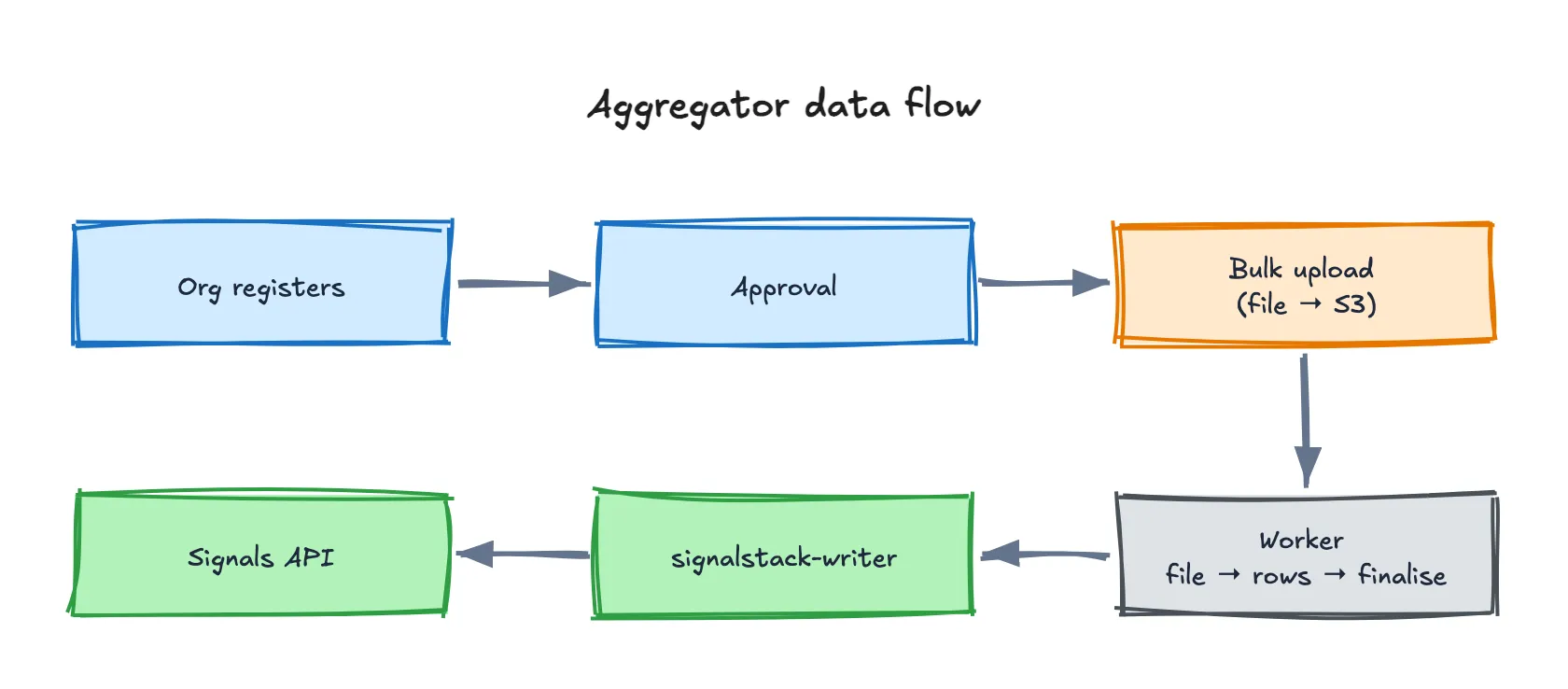
See Identity & Auth for the shared realm and the service-auth handshake with Signals.