

Items, Actions & Events
These are the records that let people and organisations nearby find each other. Inside an instance, everything is built from three primitives: items, actions and events.
An item is a versioned, schema-typed record, the unit of data in Signals. Examples: a job seeker’s profile_1.0 in the Blue Dot (jobs) domain, a job_posting_1.0, or a student’s profile_1.0 in the Yellow Dot (education) domain.
item_typeis always a schema identifier such asprofile_1.0, never freeform text.item_instance_urlanditem_schema_urlare generated by the backend at creation time. Clients must not set them.- Item tables are partitioned in the database; queries use partition-aware helpers so the planner can prune efficiently.
Action
Section titled “Action”An action is an interaction between items. Each domain lists its own actions in network.json (the code calls a domain a network):
| Domain | Action | Example |
|---|---|---|
| Blue Dot (jobs) | apply | A job seeker applies to an employer’s job posting. |
| Blue Dot (jobs) | connect | An employer invites a job seeker to an interview, or contacts another employer. |
| Yellow Dot (education) | connect | A student asks a tutor for help, or a tutor offers to help a student. |
| Purple Dot (persons with disabilities) | connect | A person with a disability and a service provider ask to connect. Either side can start. |
| Orange Dot (tourism) | None | Listings are public. Visitors call the number shown, so no action is recorded. |
An event is the structured result of an action: a stored, machine-readable record such as “this student sent a connect request to this tutor at time T, and it was accepted”. Analytics and impact measurement read events.
How they relate
Section titled “How they relate”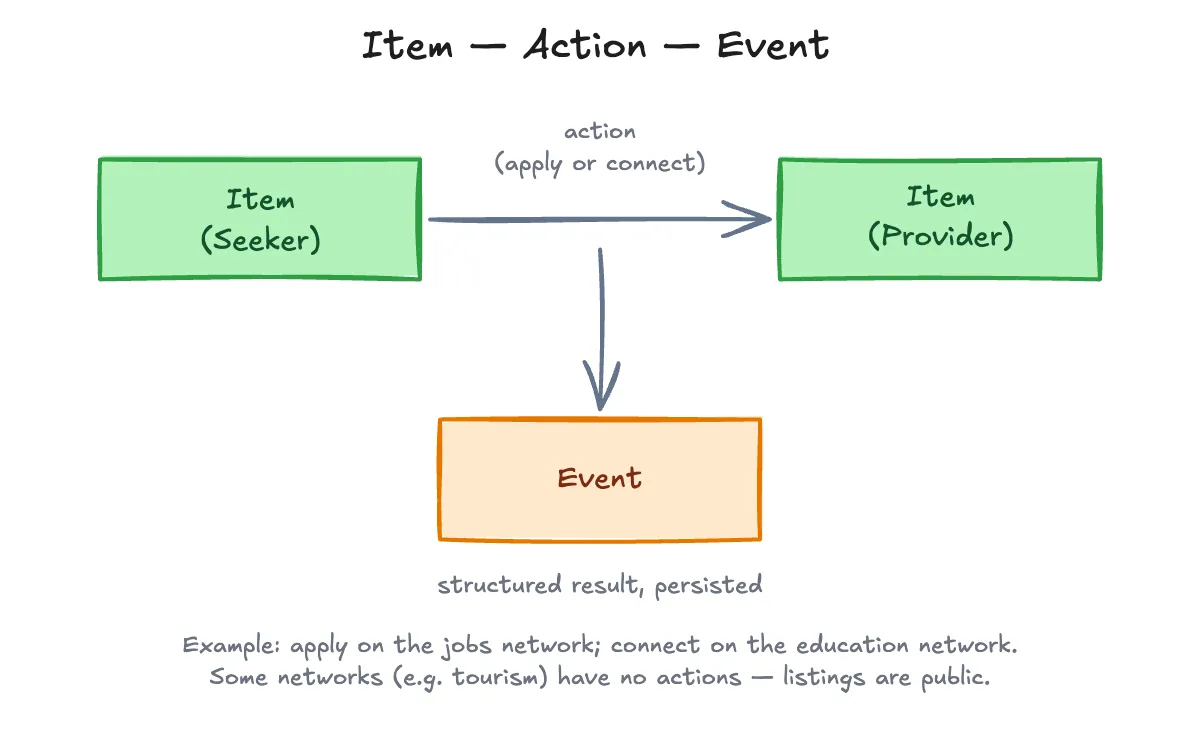
From listing to result, in these terms:
- Create items for both sides, for example a student and a tutor.
- The Signals DPG discovers compatible items.
- An action connects two items.
- An event records the outcome. Events are used to improve matching and to measure results in each district.
For how items are read locally vs. across instances, and how they are written, see Read & Write Paths. For the full term list, see the Glossary.