
Aggregators
An aggregator is a local organisation that signs participants up and checks their details, so people nearby can find and trust their blue dots. The Aggregator DPG (digital public good) is the application aggregators use.
Checking details is the main reason aggregators exist. A blue dot that a known local organisation has checked is easier for the other side to trust.
Who can be an aggregator
Section titled “Who can be an aggregator”Any organisation that people in a group already know and trust. Pink, Green and Brown are possible future domains, so their rows are examples of who could take this role.
| Domain | Organisations |
|---|---|
| Blue Dot (jobs) | Skilling centres and ITIs (Industrial Training Institutes) |
| Yellow Dot (education) | Schools, colleges and education NGOs |
| Purple Dot (persons with disabilities) | DPOs (disabled persons’ organisations) and disability NGOs |
| Orange Dot (tourism) | Tourism bodies |
| Pink Dot (women’s work, possible) | SHGs (self-help groups) |
| Green Dot (farming, possible) | FPOs (farmer producer organisations) and KVKs (Krishi Vigyan Kendras, farm science centres) |
| Brown Dot (small businesses, possible) | Trade associations |
| Any domain | Government departments |
Picking the right aggregator is step 1 of the lifecycle: the adaptor decides who to bring in, then picks the organisation that can reach them.
Why aggregators matter
Section titled “Why aggregators matter”Asking every person to sign up on their own is slow. Aggregators already work with hundreds or thousands of people. When an aggregator registers and uploads its participants in bulk, a district quickly has enough blue dots for people to find useful matches. The Ghaziabad and Dharwad jobs pilots worked this way.
What the Aggregator DPG does
Section titled “What the Aggregator DPG does”The Aggregator DPG is aggregator-facing and provides:
- Registration & approval — an organisation registers, is reviewed, and is approved onto Blue Dots.
- Organisation → coordinator hierarchy — a parent organisation owns many coordinators, and coordinators join by invitation only. See How coordinators join below.
- Profile management — schema-driven forms (RJSF) let non-engineers change registration and profile fields without code changes.
- Bulk upload — CSV/file-based creation of many participant signals at once, processed asynchronously by a background worker.
- Registration links & metrics — shareable links for self-registration, with roll-up metrics.
- Verification — the review by a person that marks a checked profile as Verified.
Intake methods
Section titled “Intake methods”An aggregator can sign people up in four built-in ways: offline camp, bulk upload, outbound campaign and inbound QR campaign. The route (assisted or self) and the intake method are chosen per campaign or area. The Blue Dot Lifecycle describes each method.
How coordinators join
Section titled “How coordinators join”Coordinators join an organisation by invitation only. The organisation owner registers, is approved, and then invites each coordinator by email. The full flow, including link lifetimes and recovery, is in Aggregator DPG Architecture.
The trust boundary
Section titled “The trust boundary”The Aggregator DPG reads from the upstream Signals stack and, in the MVP, has no write access to Signals except through the controlled bulk-create paths. Every request is scoped to a verified aggregator_id, which is never trusted from the client — it is asserted from the authenticated session. This keeps one aggregator from ever reading or writing another’s data.
Integrating DPGs (such as the Aggregator app, or a voice DPG) authenticate to Signals with a Keycloak service account. See Identity & Auth for the full model.
Relationship to Signals
Section titled “Relationship to Signals”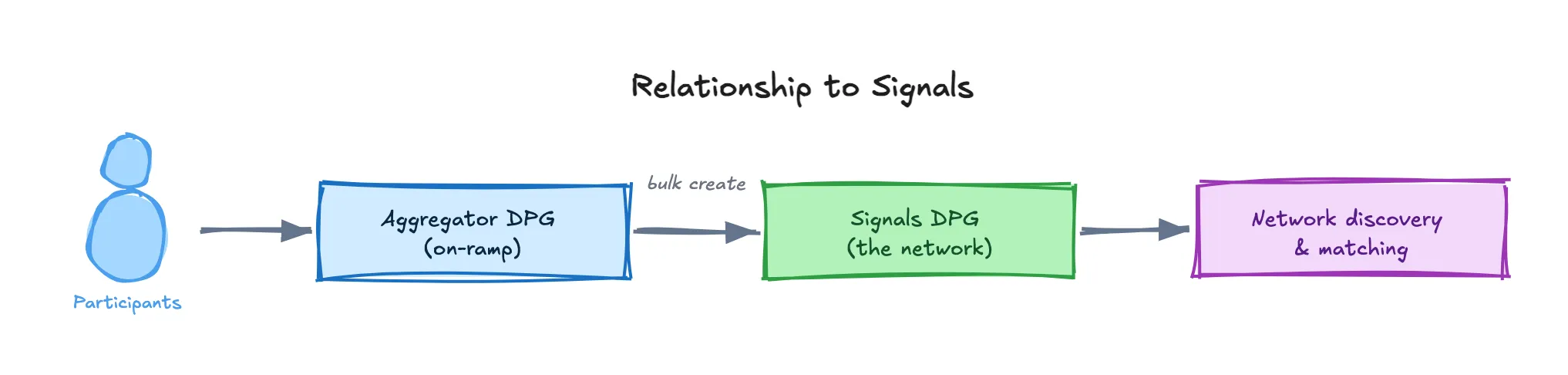
The Aggregator app brings participants in, and the Signals DPG stores and matches their blue dots. Adaptors usually stand up Signals first, then add the Aggregator app as partner organisations come on board.
Where to go next
Section titled “Where to go next”- The Blue Dot Lifecycle — the seven steps an aggregator’s participants go through.
- Aggregator DPG Architecture — the API, portal and worker.
- Aggregator DPG Setup — install and run it.