
High-Level Architecture
The Blue Dots stack is organised into clear horizontal layers, with two parallel verticals — Aggregator and Signals — that share datastores and integrations.
The layered view
Section titled “The layered view”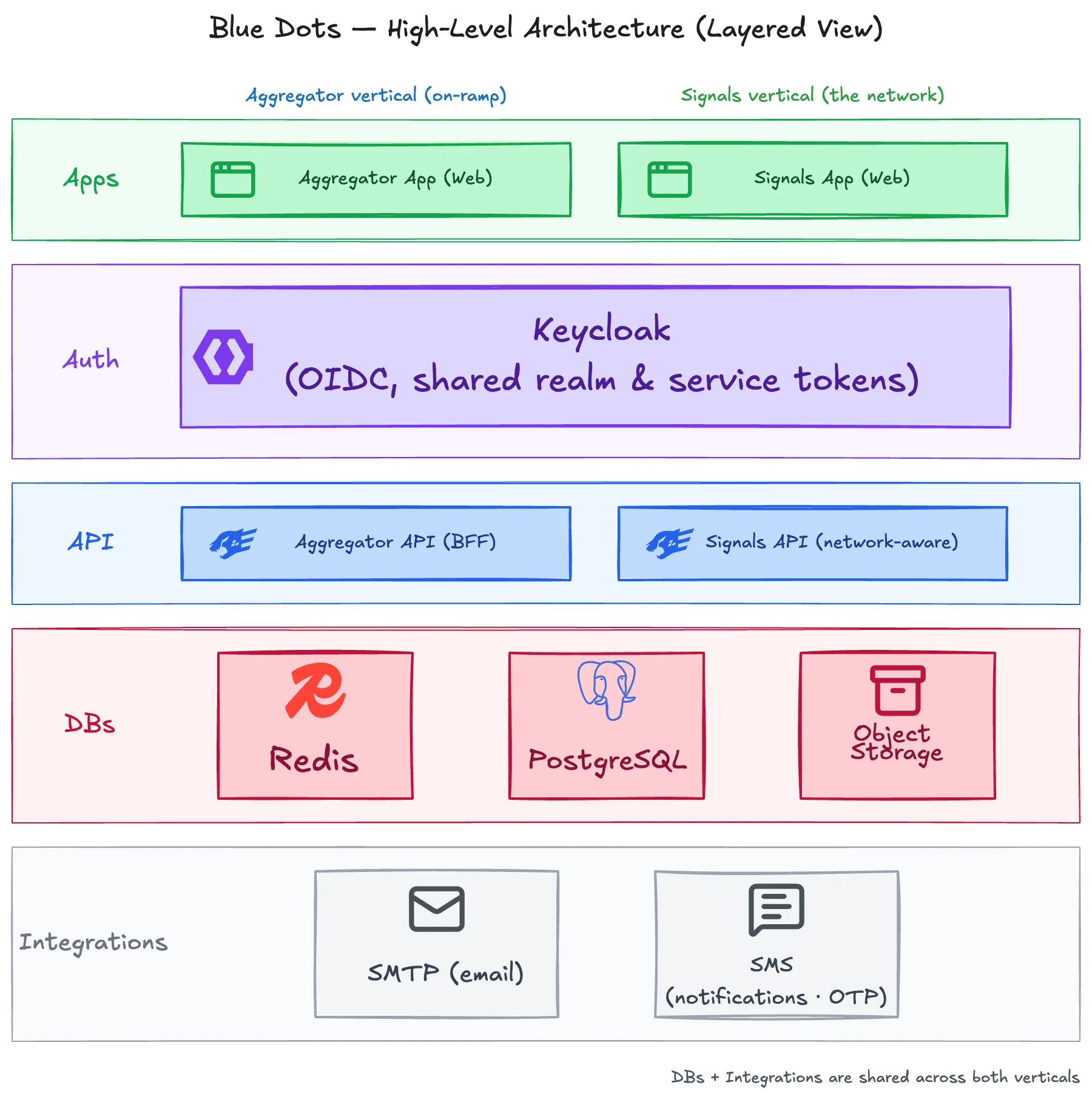
Layer by layer
Section titled “Layer by layer”Apps. Two web front-ends. The Aggregator App is the organisation-facing portal for onboarding and bulk upload. The Signals App is the schema-driven UI that renders forms and cards directly from network and item schemas.
Auth. Both verticals authenticate against one shared Keycloak realm (named per network via KEYCLOAK_REALM). People sign in with the OIDC authorization-code flow on a Keycloak-hosted login screen; integrating DPGs use client-credentials service tokens. Because the realm is shared, the API checks a token’s audience and realm role rather than trusting its signature alone. See Identity & Auth.
API. The Aggregator API is a Fastify backend-for-frontend that owns the aggregator database and the registration/approval/bulk-upload flows. The Signals API is the network-aware Fastify backend that owns items, actions, events and cross-instance discovery.
Datastores. Shared across both verticals:
- PostgreSQL — system of record (Drizzle ORM; item tables are partitioned in Signals).
- Redis — sessions, caches and the background-job queue.
- Object Storage (S3) — bulk-upload files and assets. S3 is a real cloud dependency, not part of the local Docker stack.
Integrations. SMTP for email (Mailpit locally) and SMS for notifications and OTP delivery.
Ingress & platform (cloud). In a cloud deployment, a shared common-services layer fronts both verticals with a Kong ingress controller and provisions cert-manager (TLS) and the shared Postgres + Redis. How this is provisioned and deployed is covered in Infrastructure & Deployment Architecture.
Two verticals, one network
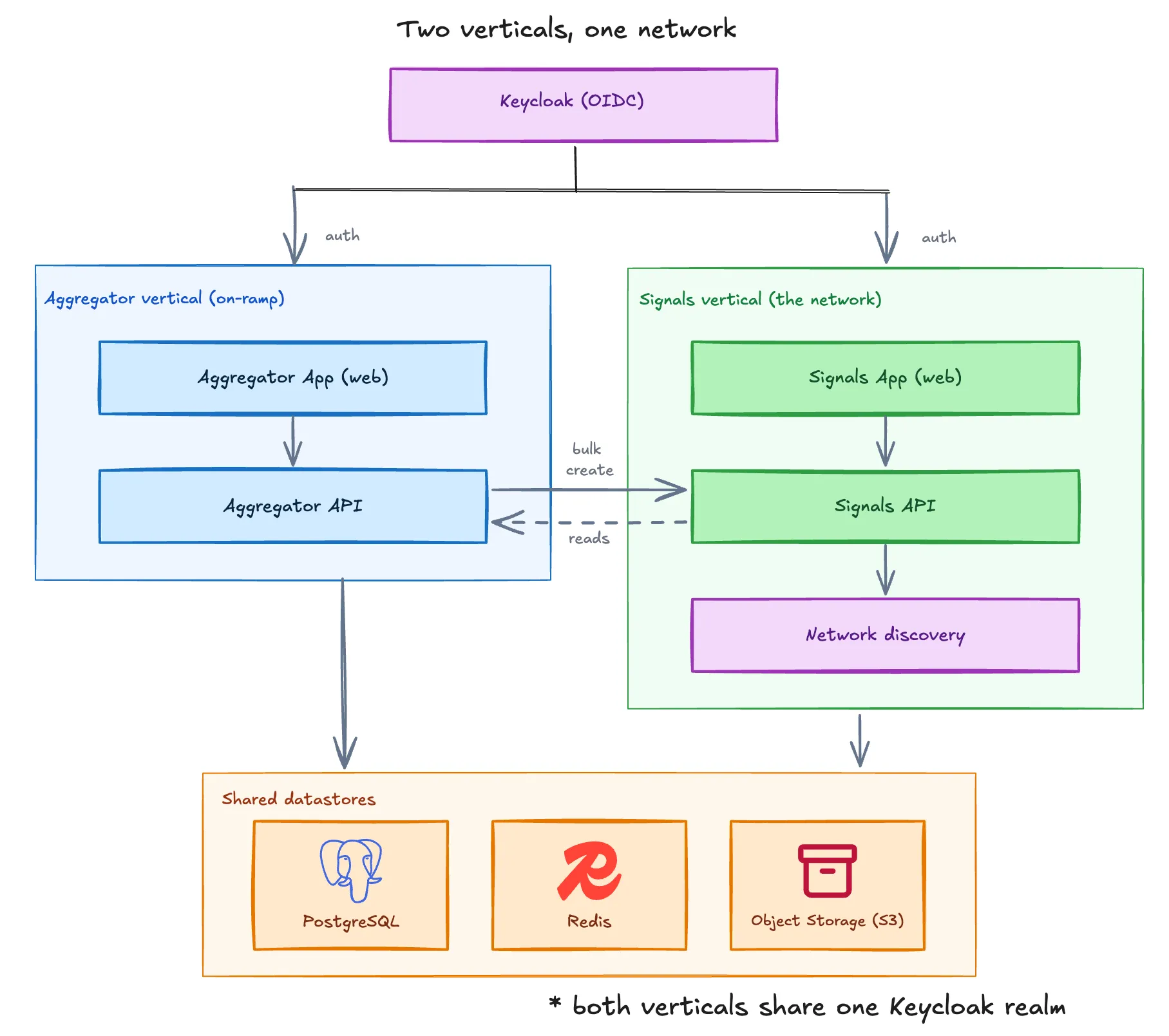
Section titled “Two verticals, one network”The Aggregator vertical is an on-ramp: it feeds participant signals into the Signals vertical, which is the network. In the MVP the Aggregator writes to Signals only through controlled bulk-create paths and otherwise reads from it.
Dive deeper into each vertical in Signals DPG and Aggregator DPG.